


Welcome back to Artcade, the newsletter with special guests. That’s right, today’s a special episode with a special guest: Mattia Ravanelli, known online as the man with a thousand editorial gigs. I made that up, but it’s not far off. Let’s just say that if “encyclopedic knowledge” had a face, it would probably be his. And, as you’ll soon realize, when it comes to music he’s second to no one either. Mattia is always worth reading, and he recently gathered all his newsletters under a single shared umbrella with Alessandro Zampini called Santa Pazienza, so you really have no excuse: one link, and you can follow and read him. What are you waiting for? Oh right, you want to read his piece for Artcade. Well then, here it is. Enjoy!
This is a special episode of Artcade. Not just because Stefano didn’t write it, but because that fact directly shapes the way this episode is put together. If you’ve developed a pleasant habit of enjoying the elegant and cultured pairings of the Master of Artcade, you may be surprised by the slapdash spirit of this installment, built on a match-up that basically introduced and declared itself. To make up for my artistic and cultural blind spots, I’ll be resorting to insufferable little tricks that reek of stale first-person anecdotes.
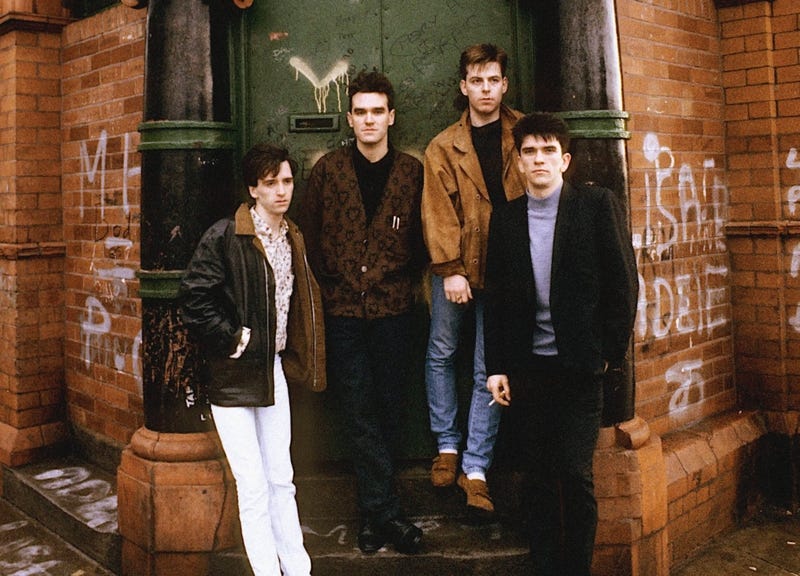
So then, in order: The Smiths, meaning the Manchester band from the Eighties. I didn’t discover them in the Eighties, but much later, with curious timing. A lucky convergence of events that gives at least a little sense to what I’m about to write. Because even though The Queen Is Dead (1986) was sitting at home on CD, universally recognized as one of the essential records of its decade and probably the album most often suggested as the place to start if you want to get into the Smiths, I had never actually listened to it.


Like so much of the music I love, the Smiths came to me as a gift from someone else. Few experiences depend on being shared as much as music does, which can be revealed, suggested, introduced by friends or relatives. And every time it works, every time you end up loving that music, it becomes a gift of literally immeasurable value. The Smiths were given to me by Roberto, one of the friends I used to write about video games with in the early 2000s for Nintendo la Rivista Ufficiale (basically Italy’s equivalent of Nintendo Power). Roberto was, and still is, passionate about video games, but above all about music, and with him we talked more often about the latter than the former. So one day we’re talking about Morrissey’s lyrics, the voice and anti-charismatic leader of the band, or Johnny Marr’s flashes of brilliance on guitar. Then he brings me a few Smiths records and a special issue of the storied Italian monthly Il Mucchio Selvaggio, retracing the story of a band that had already been dust for fifteen years by then.
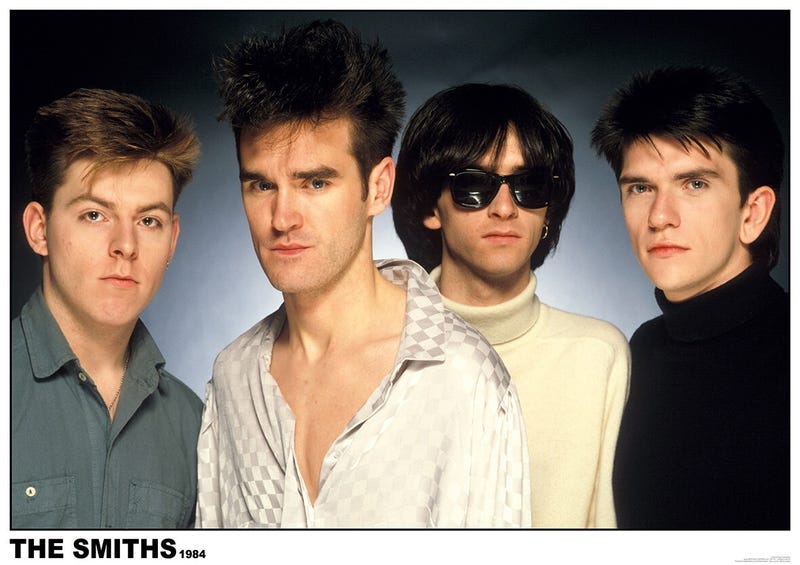
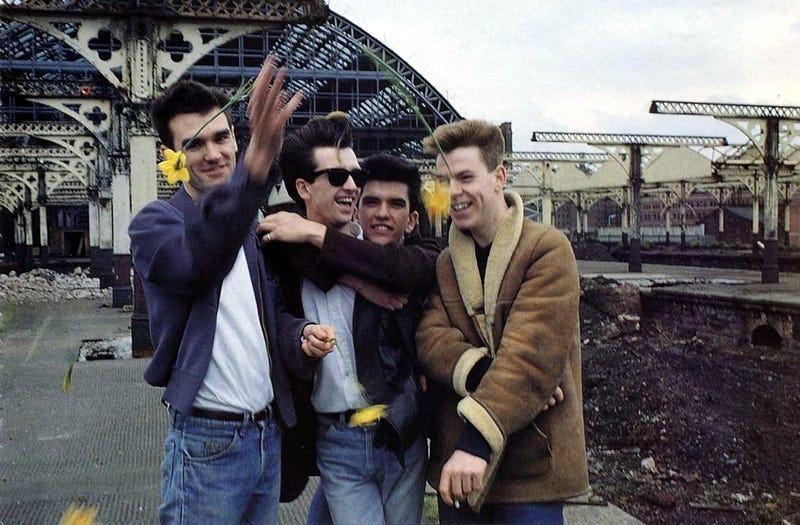
From that moment on, guided by Roberto and Il Mucchio Selvaggio, I liked The Smiths. Morrissey’s warbling voice, romantic and breezy even when dealing with terrible deaths and the terrible habits of the British people, is matched only by the natural ease with which Marr keeps pulling little tricks with his guitar. It’s instantly recognizable, and for good reason: these days he regularly shows up as a guest of honor on other people’s records, most recently the intriguing The Mountain by Gorillaz.
The Smiths manage to keep a pop lightness they really shouldn’t be able to have, considering what’s being said and the hilariously decadent, depressed tone the songs often drag around with them.
There’s that same pop lightness in killer7, the game Goichi Suda directed for Grasshopper Manufacture and Capcom in 2005. Even now, in the weeks following the release of his Romeo is a Dead Man, Suda is still mainly identified as “the guy behind killer7.” Everything he made afterward carried the same experimental charge, and the same confusion, as the hypnotic 2005 adventure, without ever quite matching its effectiveness. In the editing of certain scenes, which recalls a certain kind of Japanese action cinema, or in the aesthetic and character design of the figures in motion, extreme and/or Tarantino-esque, killer7 seems more amused with itself than it has any right to be, given the themes it deals with.
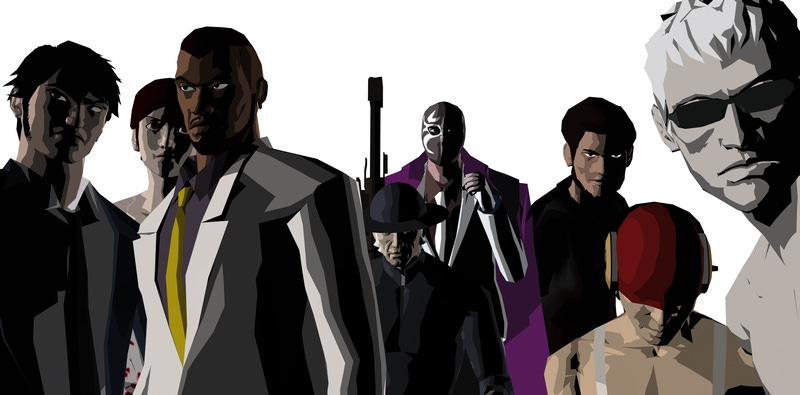


killer7 is an extremely violent game, both in the gameplay scenes where you unload firearms into wandering kamikaze-minded souls known as Heaven Smile, and in the dialogue the seven protagonists exchange with an incomprehensible and therefore unforgettable supporting cast. With the same punk fury as a twenty-year-old who wants to tear the world apart, Suda writes lines about a world in flames, drunk on sex and violent death, without ever fully bringing it into focus or maybe half-glimpsing some order that might give meaning to the whole thing. And perhaps that’s exactly why, twenty years later, it still has an allure that’s hard to describe or justify. You get the feeling there’s something more inside and behind killer7, but it’s also entirely possible there’s absolutely nothing under the dress.
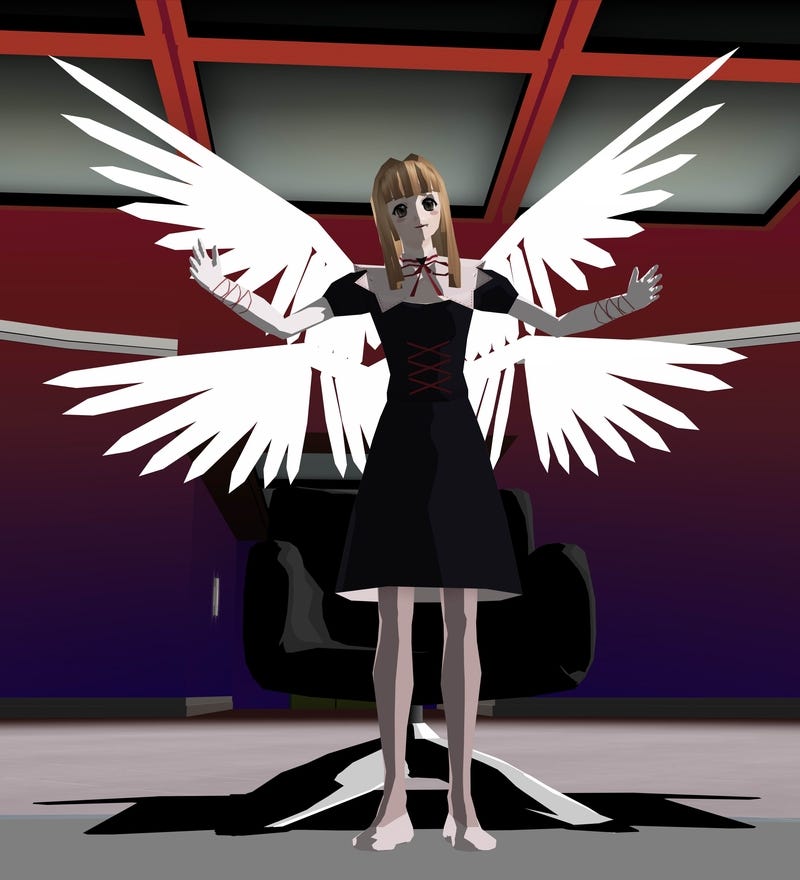
We said there were seven protagonists in killer7, but that leaves out one crucial detail: they’re all emanations of a single man, Harman Smith, an elderly professional assassin now confined to a wheelchair. Those seven are his personae, in the Latin theatrical sense of the word, meaning masks. Harman Smith becomes Garcian Smith, Dan Smith, Kaede Smith, Kevin Smith, Coyote Smith, Con Smith, and Mask de Smith. By now you’ve probably already figured out where this is going: they’re the Smiths. Not the ones from Frankly, Mr. Shankly, but Smiths all the same. At least this much is not accidental: Suda loves Seventies and Eighties punk and post-punk music, and this is his tribute.


When I played killer7 in 2005, none of this was immediately clear to me, partly because Suda’s obsession with references was only just starting to take shape and find its voice in that game. It would keep happening in the years that followed, starting with No More Heroes in 2007, which borrows its title from the best-known song by the Stranglers. But I caved in front of the titles of the letters delivered to the protagonists by carrier pigeons that show up from time to time in little corners of the levels, while you’re barreling down fixed paths, shooting, blowing things up, and understanding absolutely nothing.


Each of the eight letters bears the title of a Smiths song. First comes Still Ill, then Rusholme Ruffians, then Well I Wonder, Meat Is Murder, Back to the Old House, Half a Person, Rubber Ring, and Cemetry Gates. Back then I didn’t catch that even the pigeons’ names followed a pattern, borrowing from the so-called Bond girls, the irresistible women of the James Bond movies. When I quickly connected the dots and realized that inside one of the most anticipated games of 2005 there was this flood of passion for a great band, The Smiths, I couldn’t help developing a more intimate relationship with the work of Suda and his team. Because video games are great and interesting, but music is in a league of its own, and finding inside the former not licensed songs but the names and surnames of those songs as part of the narrative fabric... well, that was a jolt. In killer7, Suda threads The Smiths’ words into the game, showing us that there’s a passion there that goes far beyond the convenient trick of dropping a famous track into a trailer or an ending sequence.
That’s why killer7 and the Smiths are forever intertwined, and why it’s worth putting up with its slippery monologues, its rambling, the imprecision of the gameplay systems, and the lack of a clear direction in how the experience is shaped.
Gōichi Suda (2005) killer7 [キラー7] [Video game] [On-rails shooter] [Nintendo GameCube, PlayStation 2] Capcom
My last two coins
Today the video game industry has grown so large that it absorbs artistic influences of every kind. A huge monster that devours everything and spits it back out into other fields, as with the Super Mario movies or the TV adaptation of The Last of Us. Maybe that’s why I tend to forget that even twenty years ago, when you could still imagine counting the polygons on screen, video games were already entangled with all sorts of artistic forms. I really do think it’s time to explore the past as well. Is a new column on the way? Maybe. And after that outrageous tease, what is there left to add? Nothing, I’d say, other than a thank you to Mattia. Until the next episode, ciao!